The Kid From Detroit Who Quietly Trained the World's Most Famous Traders Has a Problem With the Industry He Helped Build.
Before the rented Lambos and Instagram "gurus." Before the $3M FTC fines and Discord pump groups. There was a college kid who lost $10,000 of borrowed student-loan money on one bad trade, then built something the rest of the industry has been copying for sixteen years.
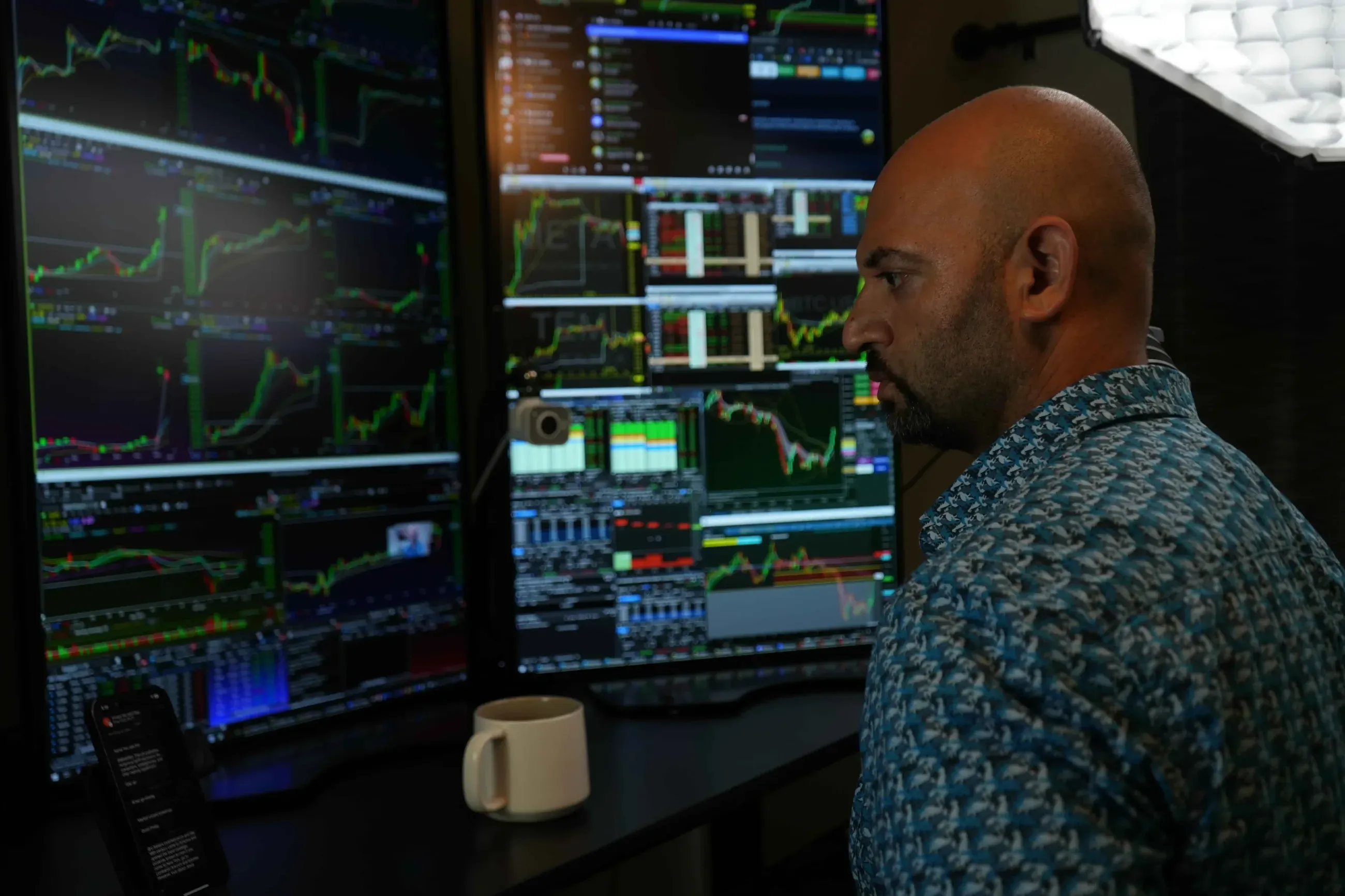
Kunal Desai has been trading professionally since 1999. He trades live for his students every weekday at 9:00 AM EST.
If you're reading this, you probably know what it feels like to stare at a red P&L and wonder what you're doing with your life.
You've watched the YouTube gurus. Maybe you bought a course. Maybe you joined a Discord where a thousand people pump the same penny stock. Maybe you paper-traded a strategy that looked perfect on the backtest and collapsed the second real money hit the account.
You're not alone. The statistics are worse than most people tell you.
Somebody is making money. It is rarely the person clicking "buy."
The man we are going to tell you about has an unfashionable answer to the question of why that is. He has been giving it, live, five mornings a week, for longer than most of the traders you follow on the internet have been alive.
It Started With a $1,000 Trade and a $10,000 Loss
In 1999, a college freshman at Michigan State sat in a computer lab at 2 AM running every ticker through MSN Money's Stock Scouter. His name was Kunal Desai. He had a dorm-room obsession and a thousand dollars his dad had handed him.
His first trade was AOL. He made $50. He was hooked.
Then the telecom crash came. Lucent. Global Crossing. Williams Communications. Companies that had traded for hundreds were suddenly worth pennies. Kunal, twenty years old and knowing nothing about the difference between "cheap" and "broken," saw opportunity.
He bought Global Crossing at $5. As it fell, he kept averaging down. By the time he finished, he had lost $10,000. Much of it was borrowed student loan money.
That loss did not make him quit. It taught him the single lesson he would spend the next twenty-four years hammering into 7,000 students after him:
Cheap stocks are cheap for a reason. Averaging down into a losing trade is the fastest way to blow up an account.
It is the kind of lesson nobody in the YouTube-highlight-reel corner of the trading world likes to teach. It doesn't sell courses. It doesn't photograph well next to a rented supercar. But it is the lesson that separates traders who are still sitting at their desks ten years from now from the ones who quietly move on, a little poorer and a little more convinced that the whole thing was rigged from the start.
Why the Trading Education Industry Is Mostly Garbage
Kunal doesn't love that we're putting it bluntly. He is, after all, the founder of a trading education company. But if you've looked for real trading instruction in the last five years, you already know.
The industry he helped create got captured by marketers who figured out that selling the dream of trading was more profitable than actually trading. They have a playbook. You've seen it:
Red Flags You've Probably Already Seen
- Pre-recorded video courses, made once in 2019, still sold as "premium" in 2026
- Discord rooms with five thousand "members" pumping the same low-float stock at 9:31 AM
- Cherry-picked screenshots of winning trades, with the twenty losses that week quietly cropped out
- Rented Lamborghinis parked in driveways of rented mansions, posing as proof of trading profit
- Countdown timers on sales pages that reset every time you refresh the browser
- "Gurus" who make their entire living selling courses, not from trading
- $3M FTC settlements against some of the biggest names in the space for misleading earnings claims
None of this is new. What's new is how much of it there is, and how easy it has become to mistake a marketing operation for a trading education.
It's Not the Strategy. It's Three Things Nobody Talks About.
If you've been stuck, if you've been stop-starting a trading career for two or three years with nothing to show for it, the reason is almost certainly not that you haven't found the right strategy.
There are, by Kunal's count, 18 proven day and swing setups that reliably work across market conditions. They've existed for decades. They are not secret.
The reason traders fail has almost nothing to do with the setups. It has everything to do with three things that get no airtime on YouTube.
1. Revenge Trading
A study of one self-described profitable trader, 58% win rate over 400 backtested trades, showed that trades he placed within 15 minutes of a loss had a 34% lower win rate than his baseline. He had a good system. His emotions were running it into the ground. This is not a character flaw. It is biology. A big loss releases cortisol, which reduces the part of the brain responsible for self-control and drives up risk-taking. You are not stronger than your cortisol response. The only fix is a system that doesn't depend on you being stronger than it.
2. No Graded Trading Plan
Ask ten struggling retail traders to show you their written trading plan. You will get ten descriptions of a vague strategy. You will not get a plan. A real plan has entry criteria, exit criteria, position sizing rules, a daily stop, a weekly review, and a performance log. Almost nobody writes one. Of the few who do, almost none have it graded by a professional who will tell them where it is broken.
3. Trading Alone
Trading is the only high-performance skill in the world where most practitioners try to learn it in complete isolation. Imagine a surgeon training alone in their basement. A pilot. A concert pianist. It would be absurd. And yet the retail trading path is: buy a course, watch it alone, trade alone, lose alone, quit alone. No feedback loop. No coach. No community that saw your trade and can tell you, from actual experience, what you just did wrong.
The fix for all three is the same. Kunal has been running it in the same format for sixteen years.
It's Not a Course. It's a 60-Day Live Trading Residency.
In 2011, Kunal formalized the teaching side of Bulls on Wall Street with something nobody else was doing at the time. He called it the 60-Day Live Trading Bootcamp.
The first one had eight students on GoToWebinar and a promise: "Whatever we lack in polish, I will make up for in effort. We go until you get it." By cohort ten, it was a full university-style program with homework, quizzes, tests, a simulator, and a curriculum built trade by trade over more than a decade of real-market refinement.
Today it is on cohort 79. It has trained more than 7,000 students. It has run, uninterrupted, for over 4,800 days. Unlike 97% of the trading courses on the market, it is still live. Every class. Every morning session. Kunal is on the other side of the screen with real money at stake.
What "Live" Actually Means
-
01
Four live evening classes per week for five weeks
Sunday through Wednesday. Interactive teaching, strategy breakdowns, homework review, live Q&A. Not a video. Not a replay.
-
02
Five live morning trading sessions per week, forever
Monday through Friday, 9:00 AM EST. Kunal's broker screen shared live. Real entries. Real exits. Real money. No "I would have taken this trade" after the fact.
-
03
Your trading plan, professionally graded
You write your own trading plan. Kunal and his team grade it. They tell you where it is broken. Then you test it in the simulator until the numbers work.
-
04
Lifetime access to every future cohort
You don't go through the bootcamp once. You are a BOWS bootcamp member for life. Come back to every future cohort. Refresh, re-learn, ship questions.
-
05
18+ proven strategies, not one "secret"
Day and swing setups refined across 79 cohorts. Gap-and-go. Opening Range Breakouts. Breakdowns. Short squeezes. Pullbacks. Earnings swings. An actual toolkit.
-
06
A community of serious traders, not a pump Discord
Chatroom access, Skool community group, post-bootcamp strategy call, ongoing accountability. People who are still there five years after their bootcamp.
The Traders You've Heard Of Were Students Here First.
This is the section Kunal would ask us to take out if he were reviewing this page. He does not like to name-drop. We are going to name-drop anyway, because it is the strongest single piece of evidence that Bulls on Wall Street is a trading school, not a marketing operation.
It is not a coincidence. The people who get serious here tend to go on and build things of their own.
Current Students, In Their Own Words
We didn't write any of these. These are bootcamp graduates talking about what the sixty days actually did to their trading.
Watch Him Actually Trade.
Most trading educators show you a chart after the fact and explain what they "would have done." Kunal doesn't. These are clips of his actual broker screen during live market hours: entries, exits, stops, mistakes, adjustments.
A Longer Conversation
If you want to hear Kunal in long form, his philosophy, how he thinks about risk, what he has seen change in 26 years of trading, this recent interview is a good place to start.
Three Stories From Graduates
"I had lost $40,000 before I found the bootcamp. Two weeks after finishing the material, I had recovered the entire loss. Now I'm a community moderator. The difference was the live instruction and being accountable to a group, not another course sitting in a folder on my desktop."
Jason · Bootcamp graduate"I tried numerous other courses before I found Bulls on Wall Street. The live instruction and the accountability made all the difference. Kunal actually answers you. He is available by text. That is not something you get anywhere else."
David · Long-time student"I'm a part-time trader with a full-time job. I was up over $100,000 in my first six weeks of 2023 using the strategies I learned in the bootcamp. The biggest thing it gave me was a process I could follow before the market opened every single morning."
Matt · Bootcamp graduate, part-time traderIndividual results vary. These testimonials reflect the students' personal experience and are not typical. Trading involves substantial risk of loss.
What Most People Ask Before Applying
How is this different from every other trading course I've tried?
I have a full-time job. Can I still do this?
Am I going to get rich?
Why is it application-only?
What does it cost?
Can I see the curriculum before I apply?
Everything You Get With the Bootcamp
The full stack. Nothing locked behind an upsell.
- ✓60 days of live interactive classes with Kunal
- ✓18 day & swing trading strategies
- ✓Personalized trading plan, graded by pros
- ✓Trading simulator + graded simulated trades
- ✓Tests, quizzes & full course materials
- ✓Lifetime bootcamp access, retake any future cohort
- ✓Skool community group
- ✓Post-bootcamp strategy call
- ✓Discounted trading account
- ✓Bulls Trading Dashboard access
A Full Year Inside the Bulls Chatroom
Trade side-by-side with Kunal Desai and Paul Singh, live every market day — for the entire year after your bootcamp.
- ✓Real-time trade alerts from Kunal Desai & Paul Singh
- ✓Daily pre-market breakdowns and game plan
- ✓Live watchlists before every open
- ✓Ongoing live commentary through the trading day
- ✓Trading Psychology Vault
- ✓Swing Trading Masterclass
- ✓Retirement Trading Course
- ✓Earnings Swing Trading
- ✓Bear Market Swing Course
- ✓AI Kunal + Automation Strategies
You won't pay anywhere close to this. Pricing is revealed on the strategy call after your application is approved — and there's no charge unless you're accepted.
Seats are capped. Applications are reviewed in the order received.
KUNAL DESAI
Trading since 1999. Still trading every morning. Still answering his phone.